Second Wednesday of Advent

Scripture Reading for Today:

Psalm 21; Genesis 15:1-18; Matthew 12:33-37

Psalm 21

For the director of music. A psalm of David.

21:1 The king rejoices in your strength, Lord.

How great is his joy in the victories you give!

2 You have granted him his heart’s desire

and have not withheld the request of his lips.

3 You came to greet him with rich blessings

and placed a crown of pure gold on his head.

4 He asked you for life, and you gave it to him—

length of days, for ever and ever.

may he crush the oppressor.

5 Through the victories you gave, his glory is great;

you have bestowed on him splendor majesty.

6 Surely you have granted him unending blessings

and made him glad with the joy of your presence.

7 For the king trusts in the Lord;

through the unfailing love of the Most High he will not be shaken.

8 Your hand will lay hold on all your enemies;

your right hand will seize your foes.

9 When you appear for battle,

you will burn them up as in a blazing furnace.

The Lord will swallow them up in his wrath,

and his fire will consume them.

10 You will destroy their descendants from the earth,

their posterity from mankind.

11 Though they plot evil against you

and devise wicked schemes, they cannot succeed.

12 You will make them turn their backs

when you aim at them with drawn bow.

13 Be exalted in your strength, Lord;

we will sing and praise your might.

Genesis 15:1-18

The Lord’s Covenant With Abram

15:1 After this, the word of the Lord came to Abram in a vision:

“Do not be afraid, Abram.

I am your shield,

your very great reward.”

2 But Abram said, “Sovereign Lord, what can you give me since I remain childless and the one who will inherit my estate is Eliezer of Damascus?” 3 And Abram said, “You have given me no children; so a servant in my household will be my heir.”

4 Then the word of the Lord came to him: “This man will not be your heir, but a son who is your own flesh and blood will be your heir.” 5 He took him outside and said, “Look up at the sky and count the stars—if indeed you can count them.” Then he said to him, “So shall your offspring be.”

6 Abram believed the Lord, and he credited it to him as righteousness.

7 He also said to him, “I am the Lord, who brought you out of Ur of the Chaldeans to give you this land to take possession of it.”

8 But Abram said, “Sovereign Lord, how can I know that I will gain possession of it?”

9 So the Lord said to him, “Bring me a heifer, a goat and a ram, each three years old, along with a dove and a young pigeon.”

10 Abram brought all these to him, cut them in two and arranged the halves opposite each other; the birds, however, he did not cut in half. 11 Then birds of prey came down on the carcasses, but Abram drove them away.

12 As the sun was setting, Abram fell into a deep sleep, and a thick and dreadful darkness came over him. 13 Then the Lord said to him, “Know for certain that for four hundred years your descendants will be strangers in a country not their own and that they will be enslaved and mistreated there. 14 But I will punish the nation they serve as slaves, and afterward they will come out with great possessions. 15 You, however, will go to your ancestors in peace and be buried at a good old age. 16 In the fourth generation your descendants will come back here, for the sin of the Amorites has not yet reached its full measure.”

17 When the sun had set and darkness had fallen, a smoking firepot with a blazing torch appeared and passed between the pieces. 18 On that day the Lord made a covenant with Abram and said, “To your descendants I give this land, from the Wadi of Egypt to the great river, the Euphrates—19 People of Zion, who live in Jerusalem, you will weep no more. How gracious he will be when you cry for help! As soon as he hears, he will answer you. 20 Although the Lord gives you the bread of adversity and the water of affliction, your teachers will be hidden no more; with your own eyes you will see them. 21 Whether you turn to the right or to the left, your ears will hear a voice behind you, saying, “This is the way; walk in it.” 22 Then you will desecrate your idols overlaid with silver and your images covered with gold; you will throw them away like a menstrual cloth and say to them, “Away with you!”

23 He will also send you rain for the seed you sow in the ground, and the food that comes from the land will be rich and plentiful. In that day your cattle will graze in broad meadows. 24 The oxen and donkeys that work the soil will eat fodder and mash, spread out with fork and shovel. 25 In the day of great slaughter, when the towers fall, streams of water will flow on every high mountain and every lofty hill. 26 The moon will shine like the sun, and the sunlight will be seven times brighter, like the light of seven full days, when the Lord binds up the bruises of his people and heals the wounds he inflicted.

Matthew 12:33-37

12:33 “Make a tree good and its fruit will be good, or make a tree bad and its fruit will be bad, for a tree is recognized by its fruit. 34 You brood of vipers, how can you who are evil say anything good? For the mouth speaks what the heart is full of. 35 A good man brings good things out of the good stored up in him, and an evil man brings evil things out of the evil stored up in him. 36 But I tell you that everyone will have to give account on the day of judgment for every empty word they have spoken. 37 For by your words you will be acquitted, and by your words you will be condemned.”

Hope is not neutral

by Angela Reitsma Bick


“Dear Nick,” one fan wrote. “I’m feeling empty and more cynical than ever. I’m scared to pass these feelings on to my little son.”

Australian rock legend Nick Cave, 68, invites fans to ask him anything, typically responding with deep compassion to one person per week. The letters are honest and raw, shot through with spiritual longing. 

Backed by his band Nick Cave and the Bad Seeds, Cave has been writing lyrics about good versus evil for more than 40 years (with – it’s probably fair to say – more fascination toward the latter than the former, at least for the first three decades). But after profound loss, the death of two adult sons: Arthur in 2015 and Jethro in 2022, Cave’s music became more introspective and abstract. And then, almost paradoxically, it moved into new territory: 2024’s Wild God is downright uplifting. Listen to “Joy” or “The Song of the Lake” and you’ll get a sense of what I mean.

Here's how Nick Cave responded to that young parent.

“Much of my early life was spent holding the world and the people in it in contempt,” Cave wrote back. “It was a position both seductive and indulgent. The truth is that I was young and had no idea what was coming down the line. It took a devastation to teach me the precariousness of life and the essential goodness of people. It took a devastation to reveal the precariousness of the world and that it was crying out for help. It took a devastation to find hope.”

What devastation, I wonder, might teach us those lessons?

And where is the hope in our current devastation? 

Salt and Light

In the first week of December, as daylight hours shortened like a noose around my energy, I came across this Advent prayer:

God, source of all light,
We are surrounded by the darkness of
the injustices experienced by your people,
the poor who are hungry and who search for shelter,
the sick who seek relief,
and the downtrodden who seek help in their hopelessness.

It matches the mood of Nick Cave’s fan. It matches the anxiety underneath the litany of conflicts, illnesses and sorrow in our church’s congregational prayers, which seem to grow longer every week. The scales feel unbalanced. We are, every one of us, desperate for hope. 

And – thanks be to God! – the promise of Advent is our assurance that the Light of the World is coming. And I loved what Joash Thomas wrote last week: that not just Jesus but we, every one of us, are the light of the world, too. Salt and light.

Surround us and fill us with your Spirit who is Light.
Lead us in your way to be light to your people.
Help us to be salt for our community
as we share your love with those caught in the struggles of life.
We desire to be your presence to the least among us
and to know your presence in them as we work through you
to bring justice and peace to this world in desperate need.

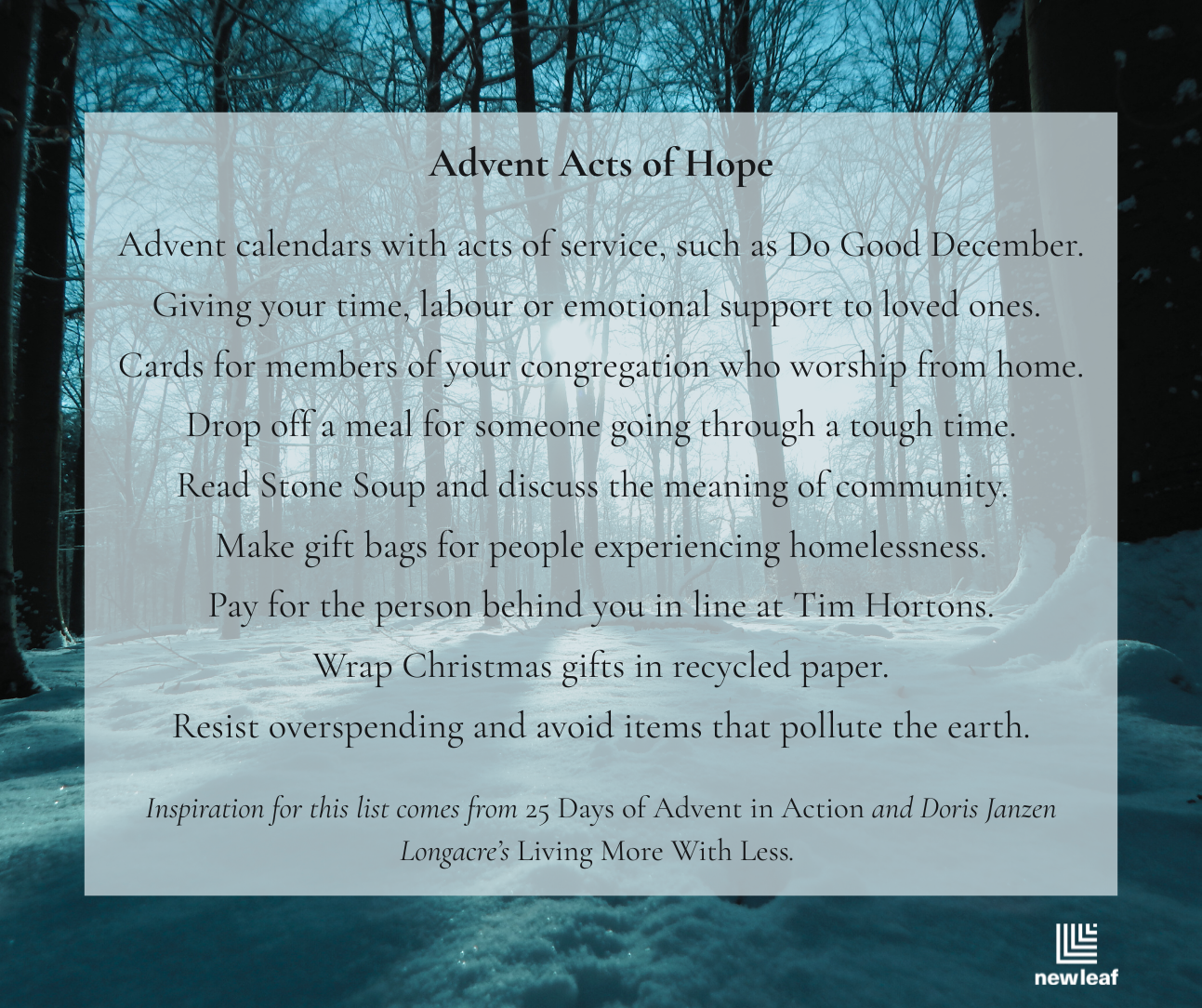
Christ’s presence on earth, which we celebrate at Christmas, needs more than celebration – it needs our participation. And the beautiful result of becoming the hands and feet of Jesus is that cynicism will naturally subside. 

In the lectionary reading for today, Jesus says that “a tree is recognized by its fruit” (Matt. 12:33). What does that mean in relation to the rest of the chapter? Well, in the preceding verses, the Pharisees had challenged Jesus, rejected him, condemned the disciples and plotted murder. Fruit of a poisonous tree. Jesus, on the other hand, had defended his disciples, rebuked the ill-intentioned Pharisees, healed two seriously ill people, inspired multitudes to follow him, quoted Isaiah – who prophesied Jesus’ injustice-fighting passion – and made a priority of feeding hungry people. Good fruit. The kind of fruit that pushes back on the darkness. 

“Unlike cynicism,” Nick Cave concluded, “hope is hard-earned and can feel like the loneliest place on earth. Hopefulness is not a neutral position. It is adversarial and it can lay waste to cynicism. Every redemptive act, as small as you like, such as reading to your little boy or showing him a thing you love or putting on his shoes, keeps the devil down in his hole. It shows the world and its inhabitants have value and are worth defending. It shows the world is worth believing in. In time, you will find that it becomes so.” 

We ask this through our Lord Jesus Christ,
your Son, who lives and reigns with you
and the Holy Spirit, one God, for ever and ever.

Amen.

Thank you for reading the New Leaf Advent Reader, a collection of reflections from writers across Canada. If you are enjoying the reader, sign up to receive the readings in your inbox here: SIGN UP

And please share this reflection with your friends and family who might also enjoy it.


Explore other Advent Reader reflections:

Explore past Advent Reader reflections: