First Wednesday of Advent

Scripture Reading for Today:
You Are The Coming Light Of The World!
by Joash Thomas

Here’s an ancient and revolutionary idea I’d like to introduce to you this Advent season: You are the light of the world.
You may read this and say, “Really? What’s so revolutionary about that? Did Jesus not say that?”
Yes, he did. And I still think we miss the point of this teaching. It’s sad how so many of us are conditioned by Empire to think that light only starts to emerge within us after we put our faith in Jesus. This is a narrow, empire-shaped view of faith that flies in the face of Jesus’ teaching to an audience that hadn’t necessarily prayed ‘the sinner’s prayer.’
Let’s read Jesus’ words in Matthew 5:14-16 (NRSVUE):
“You are the light of the world. A city built on a hill cannot be hid. People do not light a lamp and put it under the bushel basket; rather, they put it on the lampstand, and it gives light to all in the house. In the same way, let your light shine before others, so that they may see your good works and give glory to your Father in heaven.”
In the evangelical tradition I grew up in, the emphasis was more on Jesus being the light of the world than on us being the light of the world. Even in Anglican liturgy, we’re taught that “Apart from God’s grace, there is no health in us.” Because the emphasis is tragically more on original sin in Genesis 3 instead of the original goodness we see in the creation narrative of Genesis 1.
So what do we make of this? Is Jesus the light of the world, or are we the light of the world? I think there’s something deeper going on here. This concept is present in Eastern Christianity, in both Eastern Orthodox and Eastern Catholic traditions, called Theosis – the idea that as we are transformed by Christ, we start to look, smell, and taste more like Jesus. Or in other words, as we are transformed by Christ, we start to participate in God’s divine nature.
But I also think there’s something else going on here – a concept found among the ancient, indigenous, precolonial Christianity of a Western Christian tradition – the Celtic Christians, who believed that every human being (yes, even the people who piss you off on Facebook this week) is made in the image of God, and every single one of us bears the light of God from the moment of our creation. These ancients in the tradition of St. John (the beloved apostle who leaned on Jesus’ chest and heard the heartbeat of God) believed that to look at the face of a newborn baby was to look at the face of God – because we’re all made in the beautiful image and light of God, from the moment of our births.
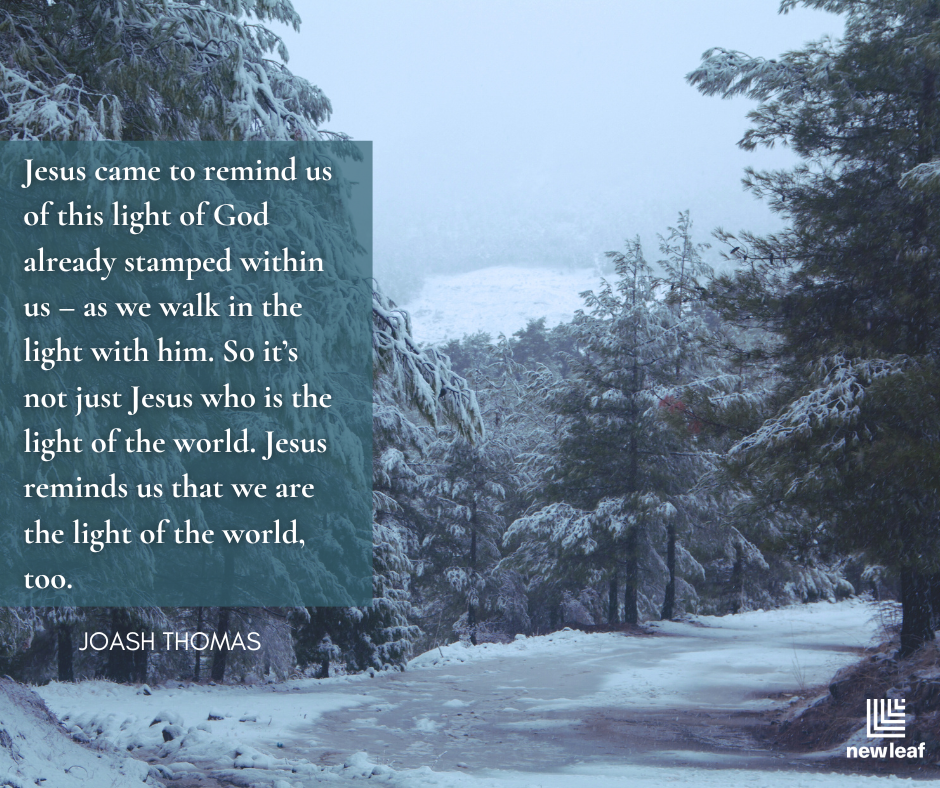
Now, many of us, because of our Empire-shaped theological minds, are inclined to wonder, “Well, if we already have light within us, why do we need Jesus?” That is a terrific question to be contemplating this Advent season. Indeed, why do we need Jesus and his light if we already have the light of God stamped within us from the moment of our creation? Ancient Celtic Christians believed that humankind tends to forget this light within us because of sin on the earth – including the sin of injustice, exclusion, and oppression (which are sins that the Bible teaches about the most). So Jesus came to remind us of this light of God already stamped within us – as we walk in the light with him. So it’s not just Jesus who is the light of the world. Jesus reminds us that we are the light of the world, too.
My own ancient, indigenous Christian ancestors (St. Thomas Indian Christians) who received the Gospel from St. Thomas the apostle in AD 52 (1500 years before the first colonizers showed up with their western missionaries of Empire) chanted this beautiful liturgy from The Holy Qurbana (our ancient, Byzantine-era liturgy) that is still chanted in our St. Thomas Orthodox, Catholic, and Anglican / Mar Thoma churches across the world today. I get to chant this at the unveiling of the altar along with my community every time I attend a Mar Thoma church service at our parish in Milton, Ontario, with the smell of frankincense (one of the Eastern wise men’s presents to Jesus in the Christmas story) filling the sanctuary:
In Your Light, we see the light, Jesus, full of light.
It’s Your Light that shines upon our world, light our minds.
The Coming Light isn’t just the light of Jesus; it’s also the light within us that often gets dimmed because of our participation in unjust systems and structures that exclude and oppress our marginalized neighbours. As I say throughout my newly released book, The Justice of Jesus, the sin of colonization was not just bad for People of the Global Majority and Indigenous communities on Turtle Island; it was also bad for the Western Church that participated in the colonial project because it shaped us to resist justice for our marginalized neighbours. Because ultimately, injustice doesn’t just dim the lights of people who are oppressed; it also dims the lights of those of us who are beneficiaries of their oppression. The coming light of Jesus awakens this dimmed light within us – for our healing and for the healing of our world. Because as we see in the creation narrative of Genesis 1, light always brings life.
As my St. Thomas Indian community has sung every Sunday for over nearly 2000 years, may the light of Jesus that shines upon our world also light the light within our bodies to join the coming light – a unified but multi-spectral light that will shine brightly until and beyond Christ’s second Advent.
Thank you for reading the New Leaf Advent Reader, a collection of reflections from writers across Canada. If you are enjoying the reader, sign up to receive the readings in your inbox here: SIGN UP
And please share this reflection with your friends and family who might also enjoy it.